
How to Play Star Wars Unlimited — Beginner’s Guide 2026
Star Wars Unlimited is one of the best trading card games available right now — and one of the most accessible. Whether you’ve never touched a TCG before or you’re coming from Magic: The Gathering or Pokémon, this guide will walk you through everything you need to know to sit down and play your first game. Let’s start from the beginning.
What Is Star Wars Unlimited?
Star Wars Unlimited is a two-player trading card game published by Fantasy Flight Games. Players build decks around iconic Star Wars characters and battle head-to-head across two arenas — Ground and Space. The goal is straightforward: reduce your opponent’s base to zero hit points before they do the same to yours.
The game launched in March 2024 with the Spark of Rebellion set and now has seven sets released, with Ashes of the Empire (Set 8) arriving July 31, 2026. It’s designed to be fast, strategic, and accessible — you can learn the basics in a single session.
What You Need to Play
A Leader Card
Every deck is built around one Leader — a double-sided card representing an iconic Star Wars character. Your leader determines which aspects you can use in deck building and provides a unique ability throughout the game. Leaders start undeployed (horizontal) and can flip into play as a unit once you meet their deploy condition.
A Base Card
Your base is your life total. It has a hit point value printed on it, and when it reaches zero you lose. Bases also contribute aspects to your deck building. Every deck has exactly one base.
A Deck of at Least 50 Cards
Your main deck must contain at least 50 cards — not counting your leader and base, which sit outside the deck. There’s no maximum deck size, but 50 cards is the competitive standard. You can run up to three copies of any non-unique card.
Damage Counters and Tokens
You’ll need something to track damage on your base and units. The Two-Player Starter Set includes counters and tokens. Many players use premium dice or custom tokens available at game stores.
Deck Building Rules
Aspects and Deck Building Legality
Every card in Star Wars Unlimited has one or more aspect icons. You can freely include cards that match your leader’s or base’s aspects. If a card has an aspect your leader and base don’t share, you can still play it — but you pay two extra resources per missing aspect. Most competitive decks are built to avoid those penalties entirely.
The six aspects are Vigilance, Aggression, Heroism, Command, Cunning, and Villainy. For a full breakdown of what each aspect means and how to build around them, see our Star Wars Unlimited card anatomy guide.
Deck Construction Summary
- Minimum 50 cards (not including leader and base)
- Exactly one leader
- Exactly one base
- Maximum three copies of any non-unique card
- Only one copy of any unique card in play at a time
Setting Up the Game
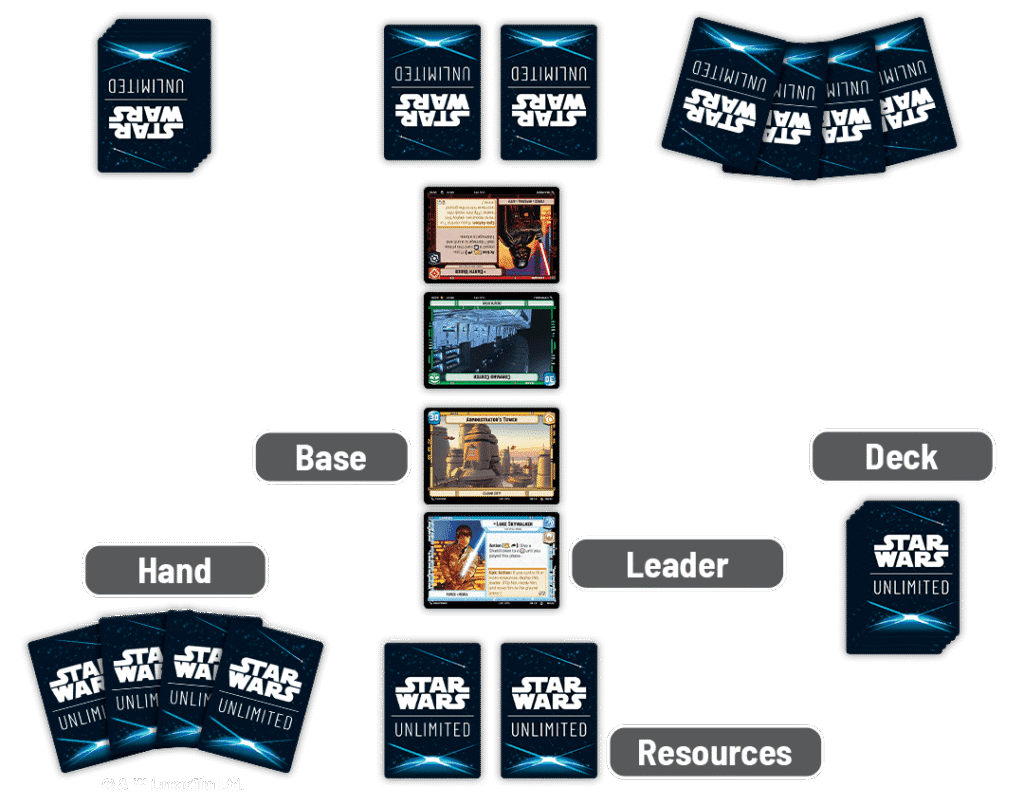
Both players set up at the same time:
Step 1 — Place Your Base and Leader
Put your base face up in the center of your play area facing your opponent. Place your leader directly below your base, horizontal side up (undeployed).
Step 2 — Determine Initiative
Flip a coin or roll a die to decide who starts with the initiative counter. The player with initiative goes first in the Action Phase each round.
Step 3 — Set Resources to Zero
Both players start with zero resources. You gain one resource per round during the Regroup Phase.
Step 4 — Shuffle and Draw
Shuffle your deck and draw six cards as your opening hand. In Star Wars Unlimited there is no mulligan — you play with what you draw.
Step 5 — Place Damage Counters
Set all damage counters and tokens aside out of play. You’ll use these during the game to track damage on your base and units.
The Three Phases of a Round
Every round of Star Wars Unlimited follows the same three-phase structure.
Phase 1 — Action Phase
This is where the game happens. Players alternate taking one action at a time until both players pass consecutively. Each action is one of the following:
Play a card — Pay its resource cost and put it into play or resolve its effect.
Attack with a unit — Exhaust a ready unit and declare an attack against an enemy unit or the opponent’s base directly.
Use an ability — Activate a card’s listed ability by paying its cost.
Take the initiative — Take the initiative counter from your opponent if they currently hold it. This is a strategic move — holding initiative means you go first next round.
Pass — Decline to take an action. If both players pass consecutively, the Action Phase ends.
Phase 2 — Regroup Phase
After the Action Phase ends both players simultaneously:
- Ready all exhausted cards (flip them back upright)
- Gain one resource (place a card from your hand face down as a resource, or gain a resource token)
- Draw two cards
Phase 3 — Ready Phase (Start of Next Round)
The next round begins. The player with initiative takes the first action.
How Combat Works
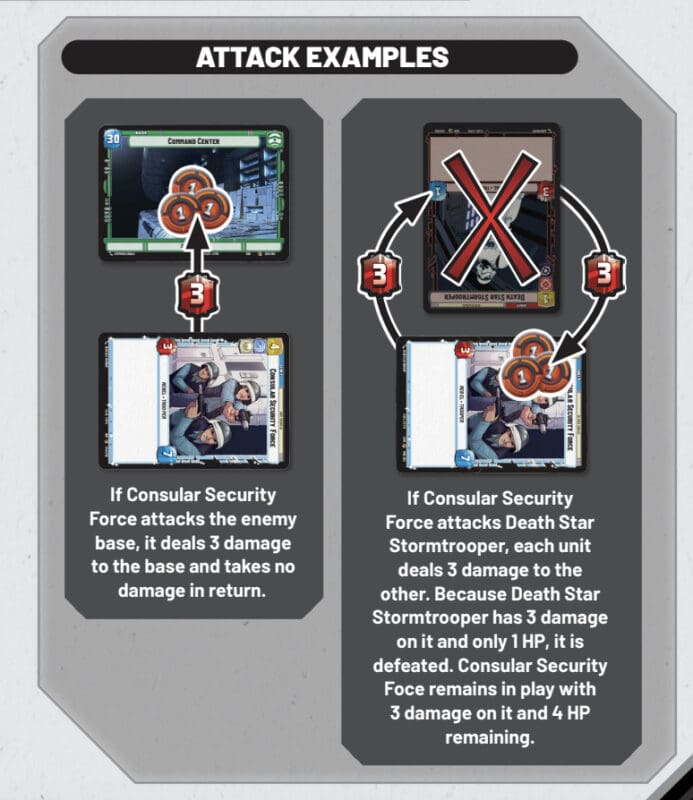
Attacking is the primary way to deal damage and win the game.
Attacking a Unit
Exhaust your attacking unit and declare it as attacking an enemy unit. Both units deal damage equal to their Power simultaneously. If a unit’s damage equals or exceeds its HP it is defeated and discarded.
Attacking a Base
If you don’t want to fight through your opponent’s units, you can attack their base directly — as long as no enemy unit with Sentinel is in play blocking that lane. Damage dealt to a base is tracked with damage counters and is permanent unless a card effect heals it.
The Two Arenas
Ground units can only attack and be attacked by other Ground units or the opponent’s base. Space units can only attack and be attacked by other Space units or the opponent’s base. You need to manage both arenas — ignoring one leaves your base exposed.
Card Types
Unit
Characters and vehicles that occupy the Ground or Space arena. They attack, defend, and generate value through their abilities. The most common card type.
Event
One-time effects played from your hand and immediately resolved. Events go to the discard pile after use.
Upgrade
Attached to a friendly unit to give it additional stats or abilities. Upgrades stay in play until the unit they’re attached to is defeated.
Base
Your home location and life total. Takes damage from attacks and some card effects. You lose when your base reaches zero HP.
Leader
Your deck’s identity card. Starts undeployed with a passive ability, and can be flipped and deployed as a powerful unit once you meet its resource condition.
Key Keywords to Know
Ambush — This unit can attack the turn it enters play. Normally units are exhausted when played and must wait a round before attacking.
Shielded — This unit enters play with a shield token. The first damage it would take is prevented and the shield is removed instead.
Sentinel — Enemy units must attack this unit rather than freely choosing their target. Sentinels protect your other units and your base.
Overwhelm — Excess damage from an attack carries over to the defending player’s base. A unit with 5 power attacking a unit with 2 HP deals 3 damage to the base as well.
Raid — Gives bonus power when attacking. Raid 2 means this unit gets +2 power on the turn it attacks.
Restore — Heals your base for the listed amount when this unit attacks.
Support — When you play this unit, you may immediately attack with another friendly unit which gains this card’s abilities for that attack. Introduced in Ashes of the Empire.
How to Win
Reduce your opponent’s base to zero hit points. That’s it. You can get there by attacking the base directly, dealing damage through card effects, or overwhelming their defenses. Most games are decided by a combination of board control, resource management, and knowing when to go for the base rather than trading units.
Formats
Premier
The main competitive format. Up to six sets are legal at any given time. Rotates every March when the oldest three sets cycle out. This is the format used for Store Championships, Planetary Qualifiers, and the Galactic Championship. For full details on what’s currently legal see our rotation guide.
Eternal
All sets ever released are legal with no rotation. Great for casual play and using your full collection. Official organized play support is available.
Twin Suns
A multiplayer format for 3–4 players using pre-constructed decks with leaders designed specifically for the format.
Limited (Draft and Sealed)
Build a deck from packs you open on the spot. No collection required — great for events and trying new sets.
How to Get Started
Step 1 — Buy a Two-Player Starter Set
The Two-Player Starter Set is the best entry point. It includes two ready-to-play 50-card decks, a quick-start rules guide, damage counters, and tokens. Pick the leaders you like the look of most and play a few games straight out of the box.
Step 2 — Learn the Cards
Once you’re comfortable with the basics, start exploring the full card pool. SWUDB.com is the best free card database and deck builder. You can browse every card ever printed and start experimenting with your own builds.
Step 3 — Practice Online
Before investing in a competitive deck, test it for free. Force Table lets you practice against AI, and Karabast connects you with real opponents online. For a full breakdown of every free simulator available see our online play guide.
Step 4 — Build Your Collection
When you’re ready to build a competitive deck, browse singles at the Skillshotz Gaming shop. Buying singles is far more efficient than cracking packs if you know what you want. Not sure what the cards mean when you’re shopping? Our card rarities guide breaks it all down.
Step 5 — Play in Person
Nothing replaces real table experience. Come play at Skillshotz Gaming in Deerfield Beach — we host Star Wars Unlimited events for players at every level from complete beginners to competitive grinders.
Frequently Asked Questions
How many cards are in a Star Wars Unlimited deck?
At least 50 cards, plus one leader and one base which sit outside the main deck.
Can I use cards from any set?
In Eternal format yes — all sets are legal. In Premier format only the six most recent sets are legal. Check our rotation guide for what’s currently legal.
What’s the best starter deck for beginners?
Any of the Two-Player Starter Sets work well. The original Spark of Rebellion starter with Luke Skywalker and Darth Vader is the most balanced starting point. The Ashes of the Empire Spotlight Decks featuring Luke Skywalker and Emperor Palpatine are also excellent for new players jumping in with the current set.
How long does a game take?
A typical game takes 20–40 minutes. Tournament matches are best-of-three.
Where can I find events near me?
Check the official Star Wars Unlimited website for organized play events, or contact Skillshotz Gaming for events in the Deerfield Beach area.
Play at Skillshotz Gaming
Skillshotz Gaming in Deerfield Beach is South Florida’s home for Star Wars Unlimited. We carry packs, singles, and accessories, host weekly events, and have a community of players ready to help new players learn the game. Come find us at 616 SE 10th Street, Deerfield Beach, FL 33441 or contact us to find out what’s on the schedule.
stars wars unlimited ashes of the empire
Star Wars Unlimited Ashes of the Empire: Everything We Know (Set 8)The next Star Wars Unlimited set is almost here. Ashes of the Empire (Set 8) releases July 31, 2026, with prereleases beginning one week earlier. Set in the era of the Battle of Endor and the rise of...

The Best D&D Experience in South Florida — And It’s Not Even Close
The Best D&D Experience in South Florida — And It's Not Even Close Let's be direct about something. There are game stores in South Florida. There are places where you can buy a D&D rulebook, sit at a folding table, and roll dice in a room that smells like...
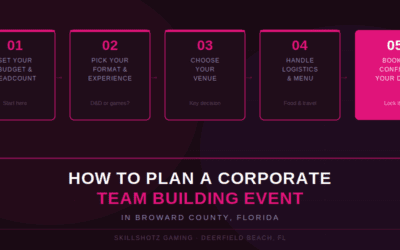
How to Plan a Corporate Team Building Event in Broward County — A Complete Guide for HR Managers and Event Coordinators
How to Plan a Corporate Team Building Event in Broward County — A Complete Guide for HR Managers and Event Coordinators Planning a corporate team building event in Broward County sounds straightforward until you actually start doing it. Suddenly there are dozens of...